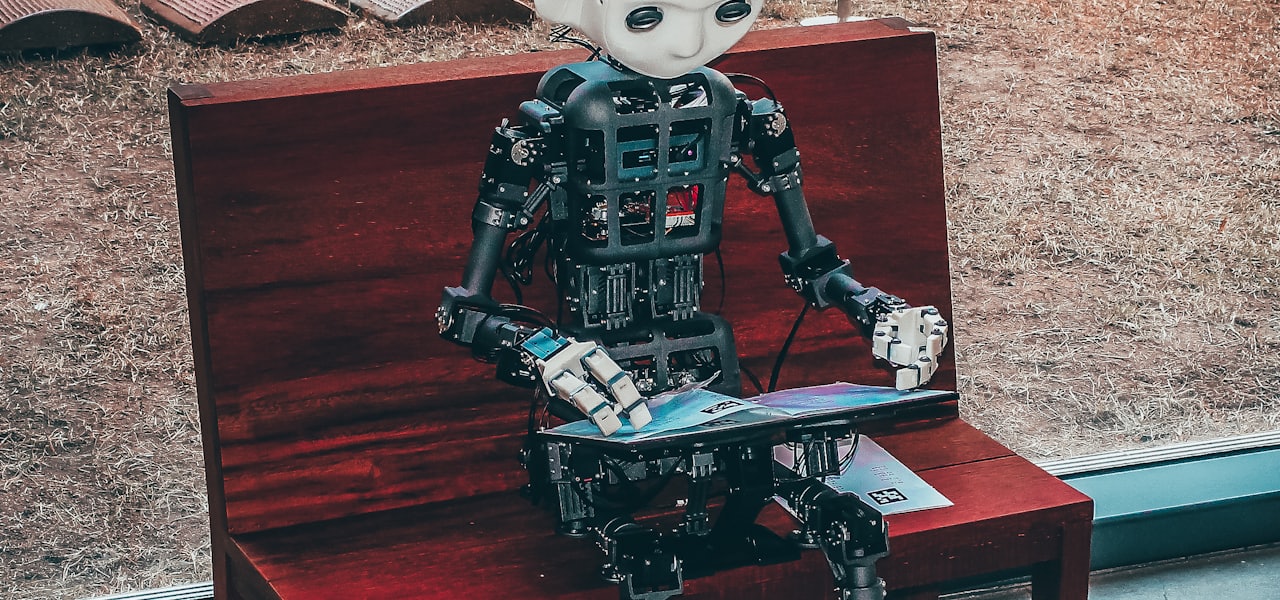
Agentic commerce (also referred to as agent-based commerce) describes an emerging form of e-commerce in which autonomous artificial intelligence (AI) agents independently execute purchasing and payment processes on behalf of users or organizations. Unlike conventional digital commerce systems, which require direct human interaction at key decision points, agentic commerce systems are designed to search for products or services, evaluate options, make purchasing decisions, and complete payments without real-time human involvement. An emerging development within the broader fields of e-commerce, fintech, and artificial intelligence; agentic commerce combines advances in generative AI, autonomous agents, application programming interfaces (APIs), and digital payment infrastructures to direct transactions with no direct human interaction. == Characteristics == A defining feature of agentic commerce is the delegation of end-to-end commercial activities to software agents. These agents typically operate according to predefined user preferences, rules, or constraints, such as price limits, quality criteria, delivery times, or preferred payment methods. Based on these parameters, an agent can autonomously perform tasks including product discovery, price comparison, contract selection, order placement, and payment execution. In contrast to decision-support systems, which provide recommendations to human users, agentic commerce systems are designed to act independently. Human involvement may be limited to initial configuration, periodic supervision, or exception handling. == Comparison with traditional and AI-assisted commerce == Traditional e-commerce requires users to manually browse products, select offers, and authorize payments. Generative AI systems used in commerce commonly assist users by answering questions or suggesting options, and do not complete transactions autonomously. Agentic commerce differs in that decision-making authority is partially or fully transferred to AI agents. As a result, the conventional customer journey, characterized by conscious decision points, may be replaced by continuous, automated micro-decisions performed by software. == Applications and business use cases == Potential applications of agentic commerce include recurring purchases, subscription management, business-to-business procurement, inventory replenishment, and price monitoring. In such contexts, transactions are often predictable and standardized, making them suitable for automation. From a business perspective, agentic commerce systems may be used to optimize supply chains, manage inventory levels, negotiate prices algorithmically, or execute transactions across multiple platforms. Enterprises adopting the new technology include retailers Walmart, Home Depot, Wayfair and Urban Outfitters, and ad tech DSPs, including Google Ads, Amazon, and Yahoo. Chinese tech firms are using apps to provide full-service shopping and payment tools. These includes Alibaba, Tencent, and ByteDance who are currently developing AI powered shopping apps. The Qwen AI chatbot allows users to complete transactions directly within its interface. US firms are still leading in developing AI models but integration is slower due to privacy restrictions. == Payments and technical infrastructure == Agentic commerce relies on digital payment systems capable of supporting automated, machine-initiated transactions, including API-based payment processing, tokenization, real-time authorization, and continuous risk monitoring. Typical user interfaces, such as shopping carts, may be replaced by backend integrations between AI agents, merchants, and payment service providers. For example, Iike 2025, Alibaba launched Alipay AI Pay, which grew and began operating as an application for different retailers. In December 2025, Alipay teamed up with Rokid to enable developers to integrate AI payments into AI agents on Rokid's Lingzhu platform. In January 2025, Alipay unveiled the Agentic Commerce Trust Protocol in partnership with Alibaba's consumer AI applications, such as the Qwen App and Taobao Instant Commerce. Qwen adopted the platform first, connecting it to Taobao Instant Commerce and Alipay AI Pay. Users could use Qwen's agentic feature to place food and drink orders within the application instead of having to click outside to an external browser. For merchants, participation in agentic commerce may require products and services to be presented in structured, machine-readable formats to ensure discoverability and interoperability with autonomous agents. == Universal Commerce Protocol (UCP) == In January 2026, Google announced the Universal Commerce Protocol (UCP), an open-source web standard intended to enable interoperability between AI agents and retail systems across the shopping journey, from discovery and checkout to post-purchase support. UCP makes use of REST, JSON-RPC transports, and support for Agent Payments Protocol (AP2), Agent2Agent (A2A), and Model Context Protocol (MCP). == Legal, regulatory, and security considerations == The use of autonomous agents in commerce raises legal and regulatory questions, particularly regarding authorization, liability, consumer protection, and fraud prevention. Existing payment and contract frameworks are generally based on human decision-makers, and their applicability to autonomous agents remains an area of active discussion. Open issues include responsibility for unauthorized or erroneous transactions, mechanisms for dispute resolution, standards for agent authentication, and compliance with data protection and financial regulations. Continuous, automated transaction patterns may also require new approaches to security and risk assessment. Traditional fraud models centered on identity verification may be insufficient for agentic commerce, and that merchants may need intent-based detection methods using machine learning and behavioral analysis to distinguish legitimate AI agents from malicious automation. === Governance frameworks === The deployment of autonomous AI agents in commercial environments has prompted the development of dedicated governance frameworks. These aim to define operational boundaries, decision authority, oversight mechanisms, and accountability structures for agentic systems. The Agentic Commerce Framework (ACF), created in 2025 by Vincent Dorange, is a governance standard that structures the deployment of autonomous AI agents around four founding principles (Decision Sovereignty, Governance by Design, Ultimate Human Control, Traceable Accountability), four operational layers, and 18 governance KPIs. In January 2026, Singapore's Infocomm Media Development Authority (IMDA) published the Model AI Governance Framework for Agentic AI, extending its existing AI governance guidelines to address agent-specific risks including delegation chains and multi-agent coordination. The Cloud Security Alliance (CSA) has also proposed an Agentic Trust Framework applying zero-trust principles to AI agent governance. == Ecosystem and implementation == The adoption of agentic commerce typically requires changes in commerce architecture, data modeling, identity and permissions, and API-based orchestration of checkout and post-purchase workflows. Management consultancies have identified agentic commerce as a structural evolution of digital commerce, emphasizing the role of AI-driven agents in automating discovery, decision-making, and transaction processes across commerce systems. McKinsey & Company has described agentic commerce as a significant shift in how consumers interact with brands and how enterprises design their commerce operating models. In Europe, this ecosystem also includes digital commerce consultancies specializing in the adoption of agentic commerce. Consulting firms such as Horrea support brands in understanding and implementing the technological and organizational shifts associated with agentic commerce. == Market development and outlook == Agentic commerce is generally regarded as an early-stage development. Industry analysts have projected that AI-driven agents could account for a small but growing share of digital payment transactions within the coming years. Due to the scale of global digital commerce, even limited adoption could represent substantial transaction volumes. Analysts expect that by 2029, AI agents could handle between 1% and 4% of all digital payment transactions. With a projected total transaction volume of over $36 trillion a year, even a small share translates into a market worth up to $1.47 trillion. According to a McKinsey study from October 2025, agentic commerce projects that by 2030, the U.S. business-to-consumer retail market alone could see up to $1 trillion in revenue orchestrated through agentic commerce. On a global scale, the opportunity could range from $3 trillion to $5 trillion. Early experiments and pilot projects have demonstrated both the potential and current limitations of the
Clubdjpro
ClubDJPro (often referred to as ClubDJ) is a DJ console and video mixing tool developed by Cube Software Solutions Inc. software. It was released in June 2005. == User interface == ClubDJPro has a GUI that was designed to allow aesthetic revisions via Skins. The skin engine that ClubDJPro uses allows for the ability to expand the software to take up the entire screen. As of 4.4.3.3 there are 3 user changeable skins included in the program which are changeable in the preferences tab. They are called 'AquaLung', 'Eleanor', and 'Grabber'. == Editions == ClubDJPro is available in two different editions, with separate features depending upon their target consumer group. DJ Edition - Can play audio files only. VJ Edition - Contains all of the features of the DJ Edition, in addition to support for video, karaoke, and visualizations. == Supported MIDI Controllers == Supported since version 2.0: Hercules Console Hercules Console MK2 Hercules Control MP3 PCDJ DAC-2 Controller == History == The initial "final release" of ClubDJPro was released on June 24, 2005. On June 26, 2009, the 4th iteration of the ClubDJPro software was released. The development of the software and website appears to have halted. As of March 2018 the website continues to show a new version "Coming Spring 2016".
Horovod (machine learning)
Horovod is a free and open-source distributed deep learning training framework for TensorFlow, Keras, PyTorch and Apache MXNet. It is designed to scale existing single-GPU training scripts to efficiently run on multiple GPUs and computer nodes with minimal code changes, using synchronous data-parallel training based on the ring-allreduce communication pattern. Horovod was initially developed at Uber and released as an open-source project in 2017, and is now hosted by the LF AI & Data Foundation, a project of the Linux Foundation. == History == Horovod was created at Uber as part of the company's internal machine learning platform Michelangelo to simplify scaling TensorFlow models across many GPUs. The first public release of the library, version 0.9.0, was tagged on GitHub in August 2017 under the Apache 2.0 licence. In October 2017, Uber Engineering publicly introduced Horovod as an open-source component of its deep learning toolkit. In February 2018 Alexander Sergeev and Mike Del Balso published a technical paper describing Horovod's design and benchmarking its performance on up to 512 GPUs, showing near-linear scaling for several image-classification models when compared with single-GPU baselines. In December 2018 Uber contributed Horovod to the LF Deep Learning Foundation (later LF AI & Data), making it a Linux Foundation project. Horovod entered incubation under LF AI & Data and graduated as a full foundation project in 2020. Since its initial release the project has expanded beyond TensorFlow to provide APIs for PyTorch, Keras and Apache MXNet, as well as integrations with frameworks such as Apache Spark and Ray, support for elastic training, and tooling for automated performance tuning and profiling. == Design and features == Horovod core principles are based on the MPI concepts size, rank, local rank, allreduce, allgather, broadcast, and alltoall. Horovod implements synchronous data-parallel training, in which each worker process maintains a replica of the model and computes gradients on different mini-batches of data. The gradients are aggregated across workers using the ring-allreduce communication pattern rather than a central parameter server, which reduces communication bottlenecks and can improve scaling on multi-GPU clusters. Communication is built on top of collective-communication libraries such as MPI, NCCL, Gloo and Intel oneCCL, and supports both GPU and CPU training. In the benchmark experiments reported in the original paper, Horovod achieved around 90% scaling efficiency on 512 GPUs for the ResNet-101 and Inception v3 convolutional neural networks, and around 68% scaling efficiency for the VGG-16 model. Horovod can be deployed on-premises or in cloud environments and is distributed as a Python package with optional GPU support via CUDA. The official documentation provides guides for running Horovod with Docker, Kubernetes (including via Kubeflow and the MPI Operator), commercial platforms such as Databricks, and cluster schedulers such as LSF. == Adoption and use cases == Within Uber, Horovod has been used for applications including autonomous driving research, fraud detection and trip forecasting. Major cloud providers have integrated Horovod into their managed machine learning offerings. Amazon Web Services supports distributed training with Horovod in services such as Amazon SageMaker and AWS Deep Learning Containers, while Microsoft Azure documents Horovod-based training workflows for Azure Synapse Analytics. Technical guides from academic and research computing centres, including Purdue University and the NASA Advanced Supercomputing programme, describe Horovod-based workflows for multi-GPU training on supercomputers and clusters. Horovod is also used in conjunction with Apache Spark and dedicated storage systems as part of end-to-end data processing and model-training pipelines. Industry blogs and technical tutorials describe deployments of Horovod on Kubernetes, on-premises clusters and cloud-managed Kubernetes services such as Amazon EKS.
Business rules engine
A business rules engine is a software system that executes one or more business rules in a runtime production environment. The rules might come from legal regulation ("An employee can be fired for any reason or no reason but not for an illegal reason"), company policy ("All customers that spend more than $100 at one time will receive a 10% discount"), or other sources. A business rule system enables these company policies and other operational decisions to be defined, tested, executed and maintained separately from application code. Rule engines typically support rules, facts, priority (score), mutual exclusion, preconditions, and other functions. Rule engine software is commonly provided as a component of a business rule management system which, among other functions, provides the ability to: register, define, classify, and manage all the rules, verify consistency of rules definitions (”Gold-level customers are eligible for free shipping when order quantity > 10” and “maximum order quantity for Silver-level customers = 15” ), define the relationships between different rules, and relate some of these rules to IT applications that are affected or need to enforce one or more of the rules. == IT use case == In any IT application, business rules can change more frequently than other parts of the application code. Rules engines or inference engines serve as pluggable software components which execute business rules that a business rules approach has externalized or separated from application code. This externalization or separation allows business users to modify the rules without the need for IT intervention. The system as a whole becomes more easily adaptable with such external business rules, but this does not preclude the usual requirements of QA and other testing. == History == An article in Computerworld traces rules engines to the early 1990s and to products from the likes of Pegasystems, Fair Isaac Corp, ILOG and eMerge from Sapiens. == Design strategies == Many organizations' rules efforts combine aspects of what is generally considered workflow design with traditional rule design. This failure to separate the two approaches can lead to problems with the ability to re-use and control both business rules and workflows. Design approaches that avoid this quandary separate the role of business rules and workflows as follows: Business rules produce knowledge; Workflows perform business work. Concretely, that means that a business rule may do things like detect that a business situation has occurred and raise a business event (typically carried via a messaging infrastructure) or create higher level business knowledge (e.g., evaluating the series of organizational, product, and regulatory-based rules concerning whether or not a loan meets underwriting criteria). On the other hand, a workflow would respond to an event that indicated something such as the overloading of a routing point by initiating a series of activities. This separation is important because the same business judgment (mortgage meets underwriting criteria) or business event (router is overloaded) can be reacted to by many different workflows. Embedding the work done in response to rule-driven knowledge creation into the rule itself greatly reduces the ability of business rules to be reused across an organization because it makes them work-flow specific. To create an architecture that employs a business rules engine it is essential to establish the integration between a BPM (Business Process Management) and a BRM (Business Rules Management) platform that is based upon processes responding to events or examining business judgments that are defined by business rules. There are some products in the marketplace that provide this integration natively. In other situations this type of abstraction and integration will have to be developed within a particular project or organization. Most Java-based rules engines provide a technical call-level interface, based on the JSR-94 application programming interface (API) standard, in order to allow for integration with different applications, and many rule engines allow for service-oriented integrations through Web-based standards such as WSDL and SOAP. Most rule engines provide the ability to develop a data abstraction that represents the business entities and relationships that rules should be written against. This business entity model can typically be populated from a variety of sources including XML, POJOs, flat files, etc. There is no standard language for writing the rules themselves. Many engines use a Java-like syntax, while some allow the definition of custom business-friendly languages. Most rules engines function as a callable library. However, it is becoming more popular for them to run as a generic process akin to the way that RDBMSs behave. Most engines treat rules as a configuration to be loaded into their process instance, although some are actually code generators for the whole rule execution instance and others allow the user to choose. == Types of rule engines == There are a number of different types of rule engines. These types (generally) differ in how Rules are scheduled for execution. Most rules engines used by businesses are forward chaining, which can be further divided into two classes: The first class processes so-called production/inference rules. These types of rules are used to represent behaviors of the type IF condition THEN action. For example, such a rule could answer the question: "Should this customer be allowed a mortgage?" by executing rules of the form "IF some-condition THEN allow-customer-a-mortgage". The other type of rule engine processes so-called reaction/Event condition action rules. The reactive rule engines detect and react to incoming events and process event patterns. For example, a reactive rule engine could be used to alert a manager when certain items are out of stock. The biggest difference between these types is that production rule engines execute when a user or application invokes them, usually in a stateless manner. A reactive rule engine reacts automatically when events occur, usually in a stateful manner. Many (and indeed most) popular commercial rule engines have both production and reaction rule capabilities, although they might emphasize one class over another. For example, most business rules engines are primarily production rules engines, whereas complex event processing rules engines emphasize reaction rules. In addition, some rules engines support backward chaining. In this case a rules engine seeks to resolve the facts to fit a particular goal. It is often referred to as being goal driven because it tries to determine if something exists based on existing information. Another kind of rule engine automatically switches between back- and forward-chaining several times during a reasoning run, e.g. the Internet Business Logic system, which can be found by searching the web. A fourth class of rules engine might be called a deterministic engine. These rules engines may forgo both forward chaining and backward chaining, and instead utilize domain-specific language approaches to better describe policy. This approach is often easier to implement and maintain, and provides performance advantages over forward or backward chaining systems. There are some circumstance where fuzzy logic based inference may be more appropriate, where heuristics are used in rule processing, rather than Boolean rules. Examples might include customer classification, missing data inference, customer value calculations, etc. The DARL language and the associated inference engine and editors is an example of this approach. == Rules engines for access control / authorization == One common use case for rules engines is standardized access control to applications. OASIS defines a rules engine architecture and standard dedicated to access control called XACML (eXtensible Access Control Markup Language). One key difference between a XACML rule engine and a business rule engine is the fact that a XACML rule engine is stateless and cannot change the state of any data. The XACML rule engine, called a Policy Decision Point (PDP), expects a binary Yes/No question e.g. "Can Alice view document D?" and returns a decision e.g. Permit / deny.
Model
A model is an informative representation of an object, person, or system. The term originally denoted the plans of a building in 16th-century English, and derived via French and Italian ultimately from Latin modulus, 'a measure'. Models can be divided into physical models (e.g. a ship model) and abstract models (e.g. a set of mathematical equations describing the workings of the atmosphere for the purpose of weather forecasting). Abstract or conceptual models are central to philosophy of science. In scholarly research and applied science, a model should not be confused with a theory: while a model seeks only to represent reality with the purpose of better understanding or predicting the world, a theory is more ambitious in that it claims to be an explanation of reality. == Types of model == === Model in specific contexts === As a noun, model has specific meanings in certain fields, derived from its original meaning of "structural design or layout": Model (art), a person posing for an artist, e.g. a 15th-century criminal representing the biblical Judas in Leonardo da Vinci's painting The Last Supper Model (person), a person who serves as a template for others to copy, as in a role model, often in the context of advertising commercial products; e.g. the first fashion model, Marie Vernet Worth in 1853, wife of designer Charles Frederick Worth. Model (product), a particular design of a product as displayed in a catalogue or show room (e.g. Ford Model T, an early car model) Model (organism) a non-human species that is studied to understand biological phenomena in other organisms, e.g. a guinea pig starved of vitamin C to study scurvy, an experiment that would be immoral to conduct on a person Model (mimicry), a species that is mimicked by another species Model (logic), a structure (a set of items, such as natural numbers 1, 2, 3,..., along with mathematical operations such as addition and multiplication, and relations, such as < {\displaystyle <} ) that satisfies a given system of axioms (basic truisms), i.e. that satisfies the statements of a given theory Model (CGI), a mathematical representation of any surface of an object in three dimensions via specialized software Model (MVC), the information-representing internal component of a software, as distinct from its user interface === Physical model === A physical model (most commonly referred to simply as a model but in this context distinguished from a conceptual model) is a smaller or larger physical representation of an object, person or system. The object being modelled may be small (e.g., an atom) or large (e.g., the Solar System) or life-size (e.g., a fashion model displaying clothes for similarly-built potential customers). The geometry of the model and the object it represents are often similar in the sense that one is a rescaling of the other. However, in many cases the similarity is only approximate or even intentionally distorted. Sometimes the distortion is systematic, e.g., a fixed scale horizontally and a larger fixed scale vertically when modelling topography to enhance a region's mountains. An architectural model permits visualization of internal relationships within the structure or external relationships of the structure to the environment. Another use is as a toy. Instrumented physical models are an effective way of investigating fluid flows for engineering design. Physical models are often coupled with computational fluid dynamics models to optimize the design of equipment and processes. This includes external flow such as around buildings, vehicles, people, or hydraulic structures. Wind tunnel and water tunnel testing is often used for these design efforts. Instrumented physical models can also examine internal flows, for the design of ductwork systems, pollution control equipment, food processing machines, and mixing vessels. Transparent flow models are used in this case to observe the detailed flow phenomenon. These models are scaled in terms of both geometry and important forces, for example, using Froude number or Reynolds number scaling (see Similitude). In the pre-computer era, the UK economy was modelled with the hydraulic model MONIAC, to predict for example the effect of tax rises on employment. === Conceptual model === A conceptual model is a theoretical representation of a system, e.g. a set of mathematical equations attempting to describe the workings of the atmosphere for the purpose of weather forecasting. It consists of concepts used to help understand or simulate a subject the model represents. Abstract or conceptual models are central to philosophy of science, as almost every scientific theory effectively embeds some kind of model of the physical or human sphere. In some sense, a physical model "is always the reification of some conceptual model; the conceptual model is conceived ahead as the blueprint of the physical one", which is then constructed as conceived. Thus, the term refers to models that are formed after a conceptualization or generalization process. === Examples === Conceptual model (computer science), an agreed representation of entities and their relationships, to assist in developing software Economic model, a theoretical construct representing economic processes Language model, a probabilistic model of a natural language, used for speech recognition, language generation, and information retrieval Large language models are artificial neural networks used for generative artificial intelligence (AI), e.g. ChatGPT Mathematical model, a description of a system using mathematical concepts and language Statistical model, a mathematical model that usually specifies the relationship between one or more random variables and other non-random variables Model (CGI), a mathematical representation of any surface of an object in three dimensions via specialized software Medical model, a proposed "set of procedures in which all doctors are trained" Mental model, in psychology, an internal representation of external reality Model (logic), a set along with a collection of finitary operations, and relations that are defined on it, satisfying a given collection of axioms Model (MVC), information-representing component of a software, distinct from the user interface (the "view"), both linked by the "controller" component, in the context of the model–view–controller software design Model act, a law drafted centrally to be disseminated and proposed for enactment in multiple independent legislatures Standard model (disambiguation) == Properties of models, according to general model theory == According to Herbert Stachowiak, a model is characterized by at least three properties: 1. Mapping A model always is a model of something—it is an image or representation of some natural or artificial, existing or imagined original, where this original itself could be a model. 2. Reduction In general, a model will not include all attributes that describe the original but only those that appear relevant to the model's creator or user. 3. Pragmatism A model does not relate unambiguously to its original. It is intended to work as a replacement for the original a) for certain subjects (for whom?) b) within a certain time range (when?) c) restricted to certain conceptual or physical actions (what for?). For example, a street map is a model of the actual streets in a city (mapping), showing the course of the streets while leaving out, say, traffic signs and road markings (reduction), made for pedestrians and vehicle drivers for the purpose of finding one's way in the city (pragmatism). Additional properties have been proposed, like extension and distortion as well as validity. The American philosopher Michael Weisberg differentiates between concrete and mathematical models and proposes computer simulations (computational models) as their own class of models. == Uses of models == According to Bruce Edmonds, there are at least 5 general uses for models: Prediction: reliably anticipating unknown data, including data within the domain of the training data (interpolation), and outside the domain (extrapolation) Explanation: establishing plausible chains of causality by proposing mechanisms that can explain patterns seen in data Theoretical exposition: discovering or proposing new hypotheses, or refuting existing hypotheses about the behaviour of the system being modelled Description: representing important aspects of the system being modelled Illustration: communicating an idea or explanation
Suno (platform)
Suno is a generative artificial intelligence music creation platform. It is designed to generate music that can include vocals and instrumentation. The platform was initially developed by Suno, Inc., of Cambridge, Massachusetts. Suno has been widely available since December 20, 2023, after the launch of a web application and a partnership with Microsoft, which included Suno as a plugin in Microsoft Copilot. The program operates by producing songs based on text or audio prompts provided by its users. Suno does not disclose the dataset used to train its artificial intelligence. == History == Suno, Inc., was founded by four people: Michael Shulman, Georg Kucsko, Martin Camacho, and Keenan Freyberg. They all worked for Kensho, an AI startup, before starting their own company in Cambridge, Massachusetts. In April 2023, Suno released their open-source text-to-speech and audio model called "Bark" on GitHub. On March 21, 2024, Suno released its V3 version for all users. The new version allowed users to create a limited number of four-minute songs using a free account. Users can pay for more features. In April 2024, a sentimental ballad was generated with Suno based on the text of the MIT License. In June 2024, a lawsuit, led by the Recording Industry Association of America, was filed against Suno and Udio alleging widespread infringement of copyrighted sound recordings. The lawsuit sought to bar the companies from training on copyrighted music, as well as damages of up to $150,000 per work from infringements that have already taken place. On July 1, 2024, a mobile app for Suno was released. On November 19, 2024, Suno upgraded its AI song model program to v4. In January 2025, Michael Shulman remarked on a podcast, "I think the majority of people don't enjoy the majority of the time they spend making music." In March 2025, one day after thousands of musicians including Thom Yorke and ABBA's Björn Ulvaeus signed a letter calling for Suno to stop training its model on copyrighted music, Timbaland endorsed Suno in a video on the company's website. In July 2025, Suno user imoliver signed a record deal with Hallwood Media, which became the first instance of a traditional music label signing an AI-based creator. Hallwood later signed with AI-artist Xania Monet for US$3 million. Monet's songs were generated by Suno AI by poet Telisha Jones. In November 2025, Suno agreed to a $500 million dollar lawsuit settlement, in which Suno would be allowed to train its models on Warner Music Group's music catalog, and WMG would control aspects of AI likeness, music, audio, software, copyrights, AI tools and music created by users on Suno. As part of the settlement, Suno also acquired the concert discovery platform Songkick from WMG. == Controversy == Suno, Inc., has been sued by the Recording Industry Association of America for copyright infringement, and thousands of musicians have signed a letter demanding that the company cease using copyrighted music in their training data. Suno does not disclose the dataset used to train its artificial intelligence.
Lumpers and splitters
Lumpers and splitters are opposing factions in any academic discipline that has to place individual examples into rigorously defined categories. The lumper–splitter problem occurs when there is the desire to create classifications and assign examples to them, for example, schools of literature, biological taxa, and so on. A "lumper" is a person who assigns examples broadly, judging that differences are not as important as signature similarities. A "splitter" makes precise definitions, and creates new categories to classify samples that differ in key ways. == Origin of the terms == The earliest known use of these terms was thought to be by Charles Darwin, in a letter to Joseph Dalton Hooker in 1857: "It is good to have hair-splitters & lumpers". But according to research done by the deputy director at NCSE, Glenn Branch, the credit is due to naturalist Edward Newman who wrote in 1845, "The time has arrived for discarding imaginary species, and the duty of doing this is as imperative as the admission of new ones when such are really discovered. The talents described under the respective names of 'hair-splitting' and 'lumping' are unquestionably yielding their power to the mightier power of Truth." They were then introduced more widely by George G. Simpson in his 1945 work The Principles of Classification and a Classification of Mammals. As he put it: splitters make very small units – their critics say that if they can tell two animals apart, they place them in different genera ... and if they cannot tell them apart, they place them in different species. ... Lumpers make large units – their critics say that if a carnivore is neither a dog nor a bear, they call it a cat. A later use can be found in the title of a 1969 paper "On lumpers and splitters ..." by the medical geneticist Victor McKusick. Reference to lumpers and splitters in the humanities appeared in a debate in 1975 between J. H. Hexter and Christopher Hill, in the Times Literary Supplement. It followed from Hexter's detailed review of Hill's book Change and Continuity in Seventeenth Century England, in which Hill developed Max Weber's argument that the rise of capitalism was facilitated by Calvinist Puritanism. Hexter objected to Hill's "mining" of sources to find evidence that supported his theories. Hexter argued that Hill plucked quotations from sources in a way that distorted their meaning. Hexter explained this as a mental habit that he called "lumping". According to him, "lumpers" rejected differences and chose to emphasise similarities. Any evidence that did not fit their arguments was ignored as aberrant. Splitters, by contrast, emphasised differences, and resisted simple schemes. While lumpers consistently tried to create coherent patterns, splitters preferred incoherent complexity. == Usage in various fields == === Biology === The categorisation and naming of a particular species should be regarded as a hypothesis about the evolutionary relationships and distinguishability of that group of organisms. As further information comes to hand, the hypothesis may be confirmed or refuted. Sometimes, especially in the past when communication was more difficult, taxonomists working in isolation have given two distinct names to individual organisms later identified as the same species. When two named species are agreed to be of the same species, the older species name is almost always retained dropping the newer species name honouring a convention known as "priority of nomenclature". This form of lumping is technically called synonymisation. Dividing a taxon into multiple, often new, taxa is called splitting. Taxonomists are often referred to as "lumpers" or "splitters" by their colleagues, depending on their personal approach to recognizing differences or commonalities between organisms. For example, the number of genera used in Pteridophyte Phylogeny Group I (PPG I) has proved controversial. PPG I uses 18 lycophyte and 319 fern genera. The earlier system put forward by Smith et al. (2006) had suggested a range of 274 to 312 genera for ferns alone. By contrast, the system of Christenhusz & Chase (2014) used 5 lycophyte and about 212 fern genera. The number of fern genera was further reduced to 207 in a subsequent publication. Defending PPG I, Schuettpelz et al. (2018) argue that the larger number of genera is a result of "the gradual accumulation of new collections and new data" and hence "a greater appreciation of fern diversity and ... an improved ability to distinguish taxa". They also argue that the number of species per genus in the PPG I system is already higher than in other groups of organisms (about 33 species per genus for ferns as opposed to about 22 species per genus for angiosperms) and that reducing the number of genera as Christenhusz and Chase propose yields the excessive number of about 50 species per genus for ferns. In response, Christenhusz and Chase (2018) argue that the excessive splitting of genera destabilises the usage of names and will lead to greater instability in future, and that the highly split genera have few if any characters that can be used to recognise them, making identification difficult, even to generic level. They further argue that comparing numbers of species per genus in different groups is "fundamentally meaningless". === History === In history, lumpers are those who tend to create broad definitions that cover large periods of time and many disciplines, whereas splitters want to assign names to tight groups of inter-relationships. Lumping tends to create a more and more unwieldy definition, with members having less and less mutually in common. This can lead to definitions which are little more than conventionalities, or groups which join fundamentally different examples. Splitting often leads to "distinctions without difference", ornate and fussy categories, and failure to see underlying similarities. For example, in the arts, "Romantic" can refer specifically to a period of German poetry roughly from 1780 to 1810, but would exclude the later work of Goethe, among other writers. In music it can mean every composer from Hummel through Rachmaninoff, plus many that came after. === Software modelling === Software engineering often proceeds by building models (sometimes known as model-driven architecture). A lumper is keen to generalise, and produces models with a small number of broadly defined objects. A splitter is reluctant to generalise, and produces models with a large number of narrowly defined objects. Conversion between the two styles is not necessarily symmetrical. For example, if error messages in two narrowly defined classes behave in the same way, the classes can be easily combined. But if some messages in a broad class behave differently, every object in the class must be examined before the class can be split. This illustrates the principle that "splits can be lumped more easily than lumps can be split". === Language classification === There is no agreement among historical linguists about what amount of evidence is needed for two languages to be safely classified in the same language family. For this reason, many proposed language families have had lumper–splitter controversies, including Altaic, Pama–Nyungan, Nilo-Saharan, and most of the larger families of the Americas. At a completely different level, the splitting of a mutually intelligible dialect continuum into different languages, or lumping them into one, is also an issue that continually comes up, though the consensus in contemporary linguistics is that there is no completely objective way to settle the question. Splitters regard the comparative method (meaning not comparison in general, but only reconstruction of a common ancestor or protolanguage) as the only valid proof of kinship, and consider genetic relatedness to be the question of interest. American linguists of recent decades tend to be splitters. Lumpers are more willing to admit techniques like mass lexical comparison or lexicostatistics, and mass typological comparison, and to tolerate the uncertainty of whether relationships found by these methods are the result of linguistic divergence (descent from common ancestor) or language convergence (borrowing). Much long-range comparison work has been from Russian linguists belonging to the Moscow School of Comparative Linguistics, most notably Vladislav Illich-Svitych and Sergei Starostin. In the United States, Greenberg and Ruhlen's work has been met with little acceptance from linguists. Earlier American linguists like Morris Swadesh and Edward Sapir also pursued large-scale classifications like Sapir's 1929 scheme for the Americas, accompanied by controversy similar to that today. === Religious studies === Paul F. Bradshaw suggests that the same principles of lumping and splitting apply to the study of early Christian liturgy. Lumpers, who tend to predominate in this field, try to find a single line of successive texts from the apostolic age to the